Access our latest freight rates, Amazon FBA pricing, and shipping resources to plan your shipments better.

U.S. CBP IOR Compliance Crackdown 2026: Importers at Risk of Deactivation
U.S. CBP is intensifying Importer of Record (IOR) compliance checks. Starting March 20, non-compliant IORs may be deactivated. Learn what this means for importers and exporters.

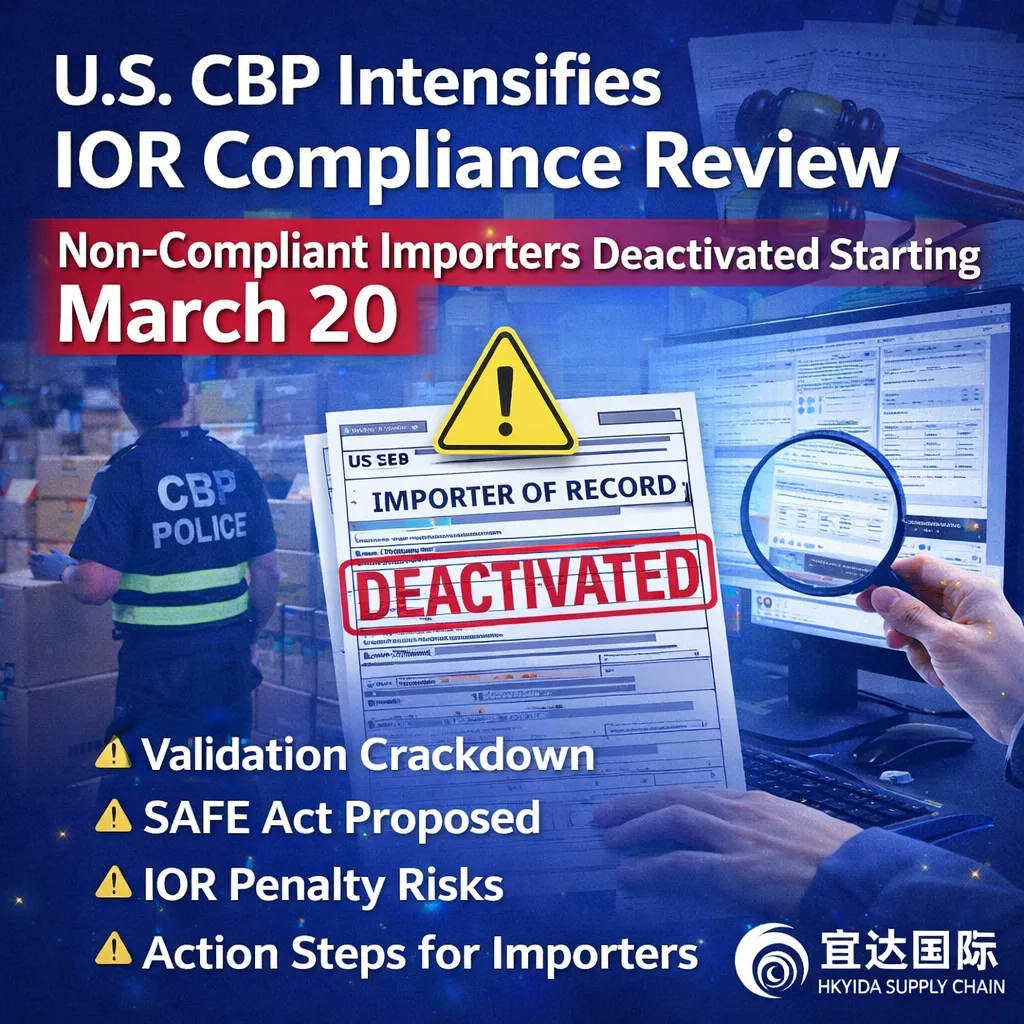
U.S. CBP Intensifies IOR Compliance Review – Non-Compliant Importers to Be Deactivated Starting March 20
Since the Chinese New Year, regulatory enforcement on U.S. customs clearance has significantly tightened, shifting from cargo inspection to importer identity verification.
From the widespread occurrence of “5H inspections”, frequent cargo holds and returns earlier this year, to the recent industry-wide circulation of CBP’s plan to clean up importer registration records, market anxiety continues to rise.
The industry focus has now fundamentally shifted to:
- Who is acting as the importer
- Who bears legal responsibility
- Whether the trade chain is authentic and traceable
1. Key Update: Large-Scale IOR Cleanup Starting March 20
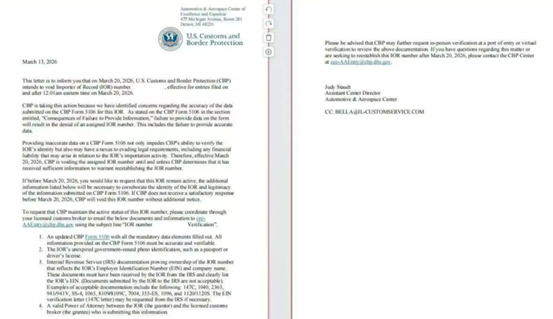
Multiple logistics providers and customs brokerage channels have confirmed that U.S. Customs and Border Protection (CBP) is initiating a comprehensive verification and deactivation campaign of Importer of Record (IOR) registrations.
Effective time: March 20, 2026, 00:01 (EST)
Non-compliant IOR numbers will be directly deactivated
What is IOR?
IOR (Importer of Record) is the legally responsible party for goods entering the United States. It is not merely a customs filing number.
The declared IOR must assume full legal responsibility for:
- Accuracy of declaration
- Duty and tax payment
- Regulatory compliance
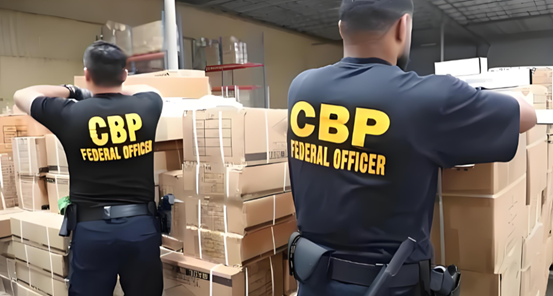
What is even more alarming is that some importers have been informed that they need to cooperate with video verification or offline real-person verification. CBP is conducting “piercing-style supervision” to confirm the authenticity of the entities.
2. Why IOR Has Become the Core Focus?
This is not an isolated action, but a natural escalation of U.S. customs enforcement.
Earlier this year:
- Large-scale 5H inspections
- Increased cargo detention / return shipments
- Risk alerts issued by major freight forwarders
The consensus is clear:
Enforcement is no longer limited to cargo, but extends to the entire trade compliance chain.
IOR = The Core Liability Node
Historically, some DDP (Delivered Duty Paid) channels relied on:
- Shared IORs
- Unclear responsibility structures
While lowering operational costs, this created risks such as:
- False declarations
- Non-compliant duty payments
- Untraceable liability
With enforcement extending to post-clearance accountability, IOR has become the primary regulatory target.
Industry Best Practices (Now Becoming Mandatory)
- Apply customs bond under the actual seller entity
- Implement Single Shipment, Single Clearance (SSSC / One Entry per Shipment)
- Ensure closed-loop trade chain
- Maintain clear and traceable liability structure
3. SAFE Act – Raising the Threshold for IOR Qualification
In March 2026, the SAFE Act was proposed in both chambers of Congress, signaling stricter IOR requirements in the future.
According to the current disclosed information, the core requirements of the bill for IOR mainly focus on four points:
- The threshold for individual entities needs to be a U.S. citizen, a legal permanent resident, or someone who can prove their actual presence in the United States.
- For corporate entities, the verification of the company’s IOR must involve a verifiable entity in the United States and acceptance of direct law enforcement by CBP.
- The traceability of the funding chain and related fees must be paid directly through the U.S. bank account bound by IOR.
- The retention of trusted partners is not a one-size-fits-all approach. High-compliance entities are expected to have some flexibility.
It should be noted that the SAFE Act is currently still in the proposal stage and has not yet officially come into effect.
The “non-U.S. entities cannot conduct IOR” that is circulating in the market is an overinterpretation, but the policy direction is very clear: authenticity, locality, and traceability are the basic foundation of future IOR.
4. Action Plan for Sellers / Shippers
In the face of the dual tightening of law enforcement and legislation, sellers need not panic excessively, but must act immediately:
1. Immediately verify the validity of the existing IOR
Confirm the IOR status with the customs broker as soon as possible to avoid the situation where the goods cannot be declared after March 20th due to the expiration of the number.
2. Prioritize the use of “true entity + single ticket single clearance”
Stop using shared IOR and unfamiliar third-party IOR, and prioritize using the store entity or a truly controllable American entity for declaration.
3. Retain complete trade documents
Keep purchase contracts, logistics documents, authorization documents, and payment records for compliance verification.
These will be essential for CBP audits and traceability inspections.
[Insert Image – Documentation / Compliance Checklist]
Conclusion
From customs inspection to person verification, the US customs clearance process is undergoing a fundamental rule reconfiguration.
The strict inspection by IOR is not a short-term incident, but a long-term trend of compliance.
In the future competition of cross-border e-commerce, it will no longer be just about price and traffic, but rather a competition in terms of compliance ability, entity qualifications, and link transparency.
Those who adapt early to the rules will be the ones who sustain long-term growth.