

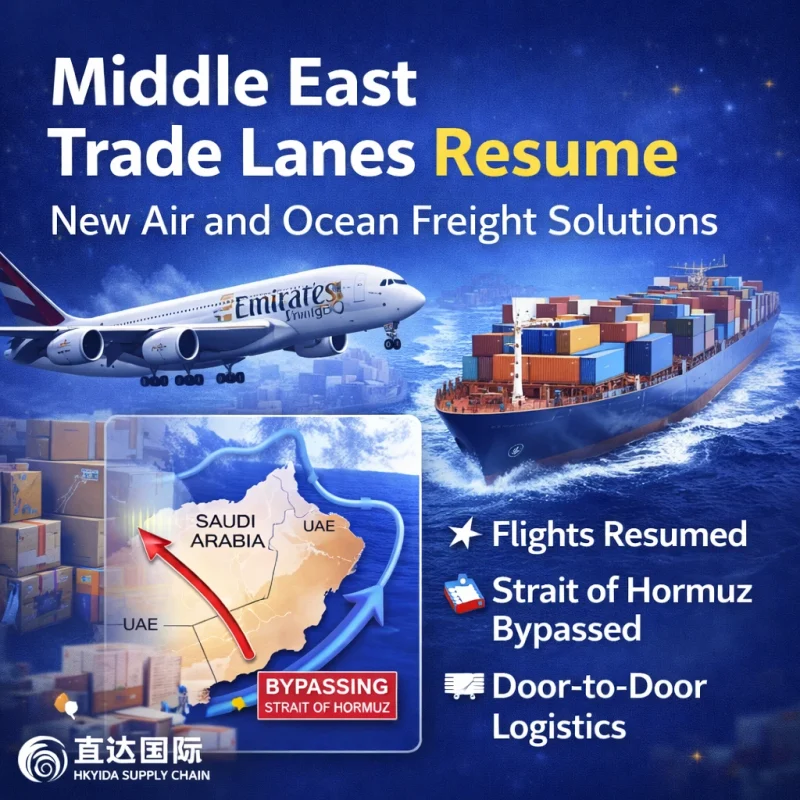
Full Resumption of Middle East Trade Lanes
The recent US–Iran tensions once caused global air cargo capacity to drop by 18%, with capacity on the core Asia–Middle East–Europe corridors plunging by more than 40%. However, the situation reversed dramatically within just one week.
Chinese airlines have taken the lead in partially restoring flights to the Middle East. Emirates SkyCargo, Etihad Cargo, and flydubai Cargo have resumed services, while Saudia Cargo has restarted freighter operations between Riyadh, Jeddah, China, and Europe.
Meanwhile, a more profound shift is taking shape in the ocean freight sector — abandoning the traditional Persian Gulf routing and completely bypassing the Strait of Hormuz. Cargo is now transported from the Indian Ocean directly to deep-water ports on the UAE’s east coast, and then delivered across the Middle East through compliant transshipment combined with cross-border trucking, enabling full door-to-door delivery across the region.
01 Air Freight Rebound · Flight Resumptions
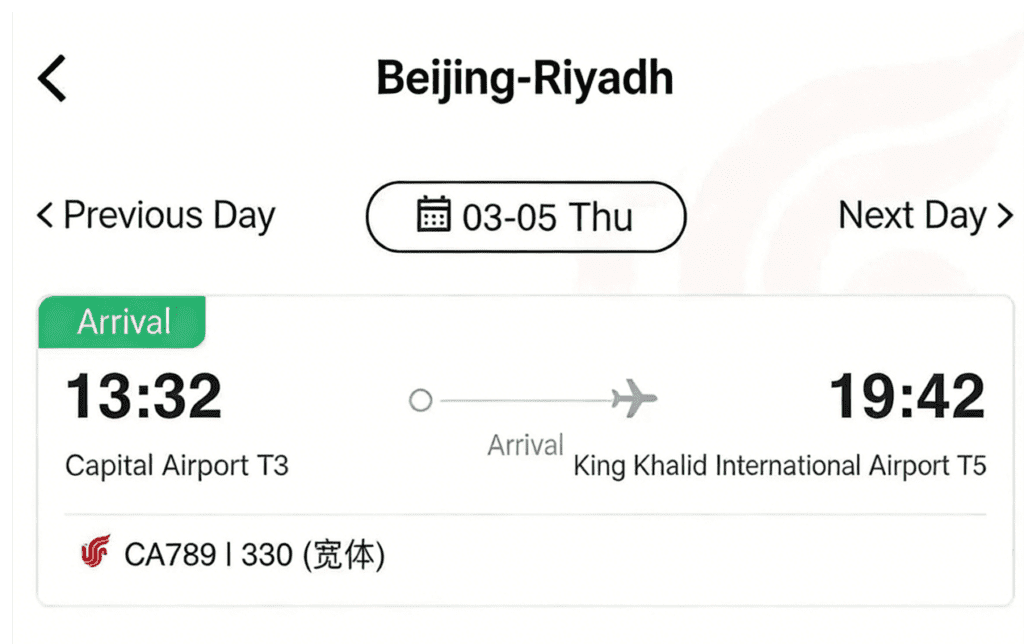
Based on safety assessments, Chinese carriers were the first to break the deadlock. Air China operated a round-trip flight between Beijing Capital International Airport and Riyadh, Saudi Arabia on March 5, followed by additional flights to Dubai in the subsequent days.
China Eastern Airlines operated a Beijing Daxing – Muscat (Oman) round trip on March 5. International carriers quickly followed.
Emirates SkyCargo resumed limited operations on the evening of March 2, becoming one of the first Middle Eastern carriers to restart services. Flight EK362 departed Dubai International Airport carrying 360 passengers and landed in Guangzhou the same evening, while EK380 departed Dubai for Hong Kong at nearly the same time.
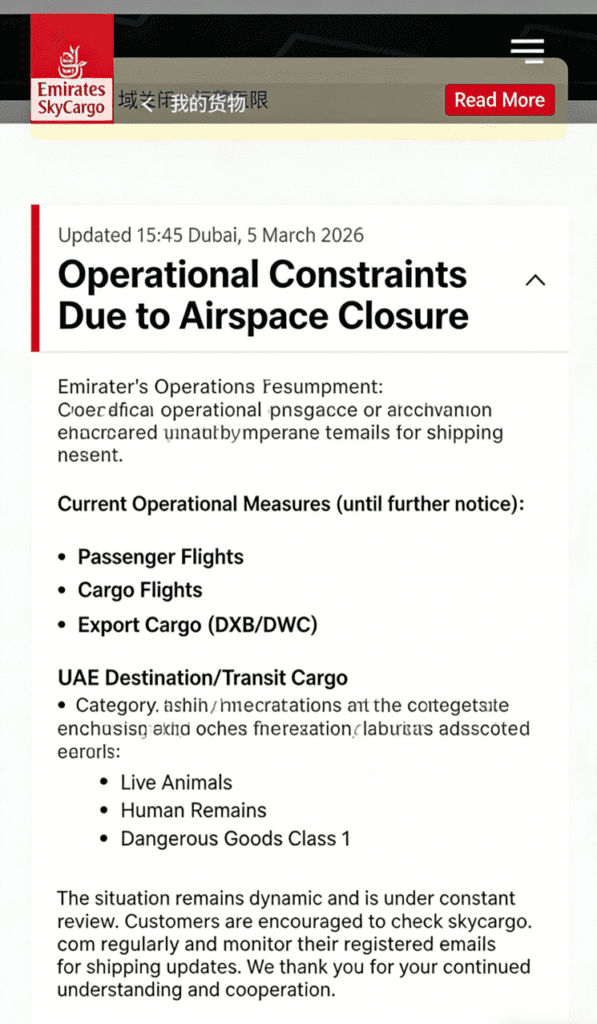
Etihad Airways announced that starting March 6 it would partially resume passenger and cargo services between Abu Dhabi and multiple key destinations.
Its freighter schedule between March 6 and March 12 covers Amsterdam, East Midlands, Ezhou, Frankfurt, Hanoi, Hong Kong, Paris, Riyadh, Shanghai, and Shenzhen.
Saudia Cargo also resumed operations. In addition to regular services, it is utilizing fifth-freedom traffic rights to operate the “Riyadh – Zhengzhou – Liège” all-cargo route, initially scheduled for two flights per week, mainly carrying electronics and cross-border e-commerce cargo.
02 Express Integrators Resume Cargo Acceptance
As regional airspace gradually reopens, global express integrators have also resumed Middle East operations.
DHL stated that it has activated business continuity and contingency plans, including alternative routing solutions as well as multimodal and trucking options for customers.
FedEx released a statement on March 4 saying:
“We continue to evaluate the situation in the Middle East. FedEx has resumed pickup and delivery services in areas where it is safe and operationally feasible, in accordance with local guidance.”
Although pickup and delivery services remain suspended in Iraq and Bahrain, transit times for shipments to and from the Middle East may still be extended, indicating that logistics channels are largely reopening.
The resumption of cargo acceptance by DHL and FedEx across multiple Middle Eastern markets is a major positive signal for exporters handling B2C shipments, samples, and small batch orders.
Previously, many cross-border e-commerce sellers targeting the Middle East had to either suspend shipments or use extremely expensive logistics solutions due to disruptions, which severely eroded margins.
Now the situation has improved significantly:
- Normal cargo acceptance has resumed
- Transit times are becoming predictable again
- Freight rates are gradually returning to normal levels
- Customers no longer need to wait a month to receive their goods
Suggestion:
If you previously lost Middle Eastern clients due to logistics disruptions, consider proactively sending them an email or WhatsApp message informing them that logistics services have resumed and shipments can now be arranged normally. Such proactive communication can often help recover old customers.
03 New Ocean Freight Solution · Bypassing the Strait of Hormuz
While air freight is recovering rapidly, a deeper transformation is emerging in the ocean freight sector.
To mitigate geopolitical risks associated with the Strait of Hormuz, a new logistics solution is being implemented: abandoning traditional Persian Gulf port calls and completely bypassing the Strait of Hormuz.
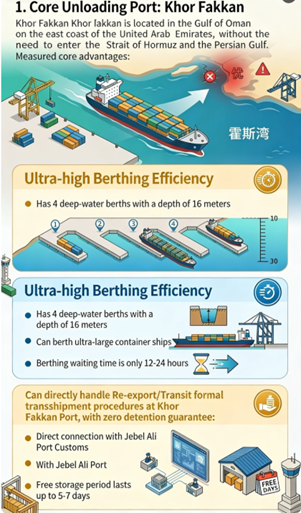
The operational route is as follows:
Cargo is shipped to deep-water ports on the UAE’s east coast (such as Fujairah), completely avoiding the Strait of Hormuz. From there, cargo moves by overland trucking into Saudi Arabia and is then distributed across the Middle East.
Logistics and supply chain experts point out that Saudi Arabia has highly developed road infrastructure. Major transport corridors connect Jeddah Port with domestic consumption hubs and Gulf border crossings.
This “sea + land” multimodal transport model avoids both the regulatory risks of the Strait of Hormuz and potential military conflicts in the Persian Gulf, making it one of the primary contingency solutions for Middle East cargo transportation.
04 Middle East Door-to-Door Delivery Becomes Reality
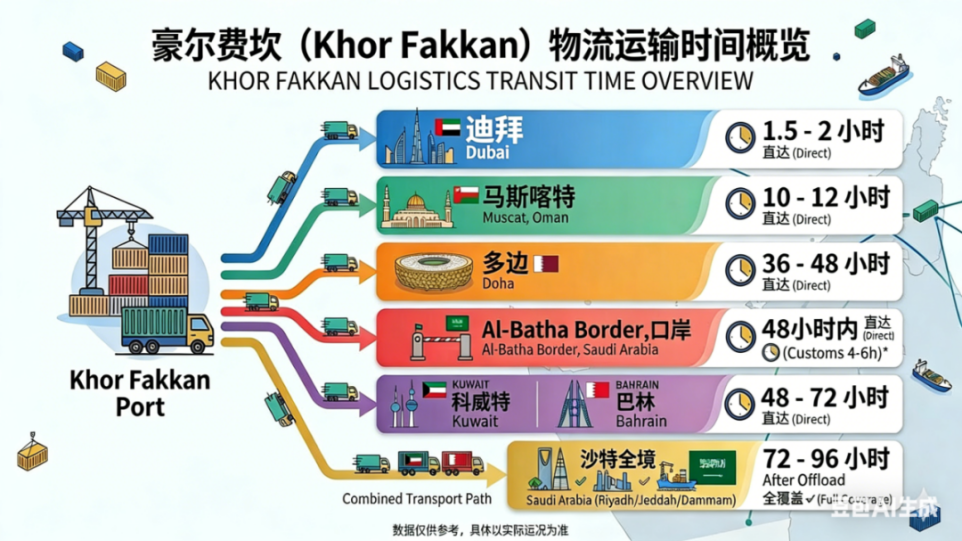
This new ocean freight solution deserves serious consideration from exporters.
Traditional routing:
Cargo enters the Persian Gulf → passes through the Strait of Hormuz → arrives at Jebel Ali Port (Dubai) → then undergoes regional distribution.
New routing:
Cargo arrives at UAE east coast deep-water ports (such as Fujairah) → trucked into Saudi Arabia → distributed across the Middle East.
What does this mean for exporters?
1. Lower transportation risk
Cargo no longer needs to pass through the Strait of Hormuz, significantly reducing war risk surcharges and port congestion risks.
For exporters shipping high-value goods such as electronics, machinery, and precision instruments, this is an important selling point when communicating with buyers.
2. Easier access to the Saudi market
Saudi Arabia is currently the largest growth market in the Middle East.
Previously, many exporters hesitated due to customs clearance and transportation complexities.
With direct land transport from the UAE east coast into Saudi Arabia, the Saudi market is effectively opened through an alternative logistics gateway.
3. Adjustments in pricing strategy
With the east-coast-plus-trucking solution available, freight forwarders and exporters can quote full door-to-door rates directly to destinations such as Riyadh, Jeddah, Doha, or Kuwait City.
Door-to-door logistics services often create higher value-added opportunities and better margins.
05 Practical Recommendations for Exporters
1. Segment Middle East orders
Urgent cargo / samples / high-value goods
→ Ship via air freight, as airline capacity is recovering and transit times are reliable.
General cargo / large shipments / Saudi-bound cargo
→ Consider the UAE east coast + overland trucking multimodal solution.
E-commerce parcels
→ DHL and FedEx have resumed services and can be used normally.
2. Reconnect with previous Middle Eastern clients
Send a simple message such as:
“Good news — logistics services to the Middle East have fully resumed. Both air and sea freight options are now available, and we can process shipments normally again. Do you have any upcoming procurement plans?”
Many clients may assume shipments are still suspended or may have switched suppliers. Proactive outreach can recover valuable business opportunities.
3. Logistics stability strengthens negotiation power
When negotiating prices or delivery schedules with Middle Eastern buyers, exporters can emphasize that logistics channels have returned to normal operations.
Stable logistics improves reliability and strengthens your position in commercial negotiations.
06 Conclusion
Wishing all exporters continued order growth in the Middle East market and smooth payment settlements.