Access our latest freight rates, Amazon FBA pricing, and shipping resources to plan your shipments better.

Alaska Shipping Cost Case Study: How the Right Channel Saved RMB 43.20
A YIDA quotation case study showing how channel selection—not a change in chargeable weight—produced a RMB 43.20 difference on one shipment to Alaska.

Updated: 11 November 2026 | A shipment-specific case study for exporters comparing freight options to remote U.S. destinations.
Shipping one carton to Alaska can involve more than comparing headline rates. This YIDA quotation case shows how the shipment’s actual weight, dimensional weight and channel rate were evaluated—and why the recorded RMB 43.20 difference came from the quoted channel rates, not a change in chargeable weight.
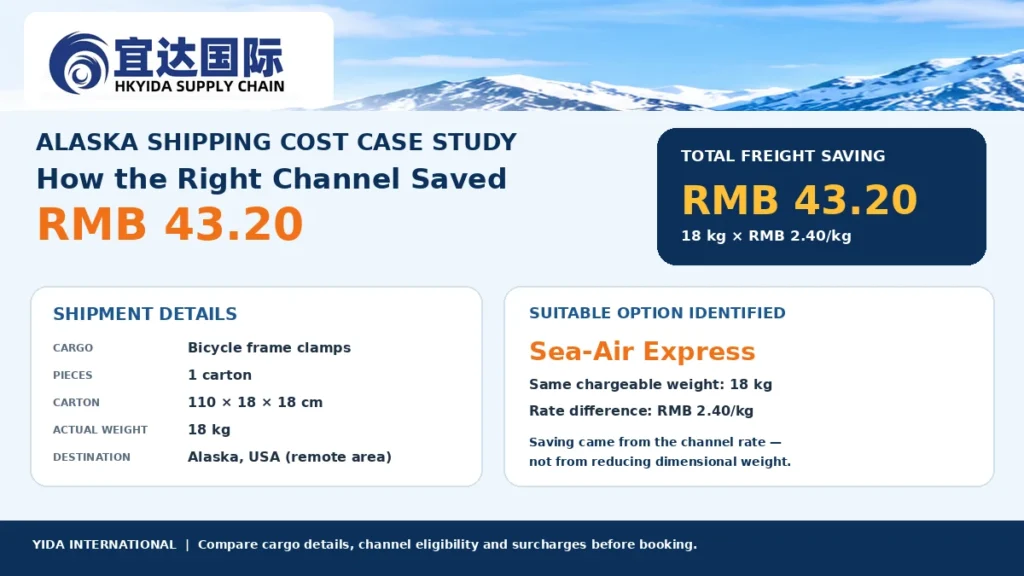
The case involved one 18 kg carton of bicycle frame clamps measuring 110 × 18 × 18 cm. The source comparison recorded a RMB 2.40/kg rate difference between the sea-air express option and the commercial-express comparison. This is one historical quotation example, not a current tariff or guaranteed saving.
Important case qualification: The 5,000 and 6,000 divisors, RMB 2.40/kg rate difference, Alaska destination coverage and no-overlength-surcharge note are recorded in this specific source case. Confirm current service availability, postcode coverage, measurement rules and all charges with YIDA operations before making a booking or delivery commitment.
The shipment at a glance
| Goods | Bicycle frame clamps |
|---|---|
| Pieces | 1 carton |
| Dimensions | 110 × 18 × 18 cm |
| Recorded actual weight | 18 kg |
| Destination | Alaska, USA (remote area) |
| Quoted rate difference | RMB 2.40/kg |
| Calculated difference | RMB 43.20 |
1. Screen the available channels first
The first step in the source case was to check which options would accept the shipment and serve the destination. The particular trucking option evaluated was ruled out because the one-carton shipment did not meet that option’s volume or acceptance requirements.
The alternative recorded in the case was a sea-air express arrangement: an international sea-air movement followed by last-mile express delivery. The source says that this option accepted a single carton and covered the stated Alaska destination.
Do not generalize the trucking decision. This case does not establish that all LTL or trucking providers reject single-piece cargo. Acceptance, minimum charges, pickup arrangements and remote-area coverage vary by provider, lane and shipment dimensions.
2. Calculate dimensional weight using each quoted service factor
Carriers and logistics providers may compare actual weight with dimensional (volumetric) weight. The higher figure is commonly used as the basis for chargeable weight, subject to the selected service’s measurement rules, rounding, minimum billable weight and contract terms.
The source quotation comparison recorded two factors: 5,000 for the sea-air express option and 6,000 for the commercial-express comparison. These are the factors recorded for this case only; they must not be treated as universal industry defaults.
| Comparison | Calculation | Dimensional weight |
|---|---|---|
| Sea-air option (case factor 5,000) | 110 × 18 × 18 ÷ 5,000 | 7.128 kg ≈ 7.13 kg |
| Commercial-express comparison (case factor 6,000) | 110 × 18 × 18 ÷ 6,000 | 5.94 kg |
| Recorded actual weight | Source-recorded actual weight | 18 kg |
Both calculated dimensional weights are below the recorded actual weight of 18 kg. The comparison therefore uses 18 kg as the higher weight for both options, before any service-specific rounding or minimum charges.
3. Where did the RMB 43.20 difference come from?
The two options had the same chargeable weight in the case calculation: 18 kg. The difference therefore came from the quoted per-kilogram rates, not from a lower dimensional weight.
Recorded rate difference: RMB 2.40 per kg
18 kg × RMB 2.40/kg = RMB 43.20
The source also records that the carton was within the selected sea-air option’s last-mile size limit and that no overlength surcharge applied to this quotation. Reconfirm this for every new shipment.
4. Three checks exporters should make before booking
Check channel eligibility first
For one-piece or low-volume shipments, ask providers which services accept the cargo, whether pickup is available and whether the destination postcode is covered. Do not assume that trucking, express or sea-air is automatically the cheapest or available option.
Classify the shipment by density
Compare actual and dimensional weight using the divisor and rounding rules quoted for each specific service. For dense cargo where actual weight is higher, compare unit rates and minimum charges. For bulky, lightweight cargo, dimensional weight can dominate, so the divisor and dimensional limits become especially important.
Confirm remote-area and size-related charges
For Alaska, Hawaii and other remote destinations, ask whether the quote includes remote-area delivery, fuel or handling surcharges, overlength fees, residential delivery, address corrections and other last-mile charges. Check the full destination postcode and carton measurements before confirming the order.
Conclusion: compare the complete quote, not one rate line
This Alaska case illustrates a practical point: a lower freight cost may come from matching cargo to an eligible channel with a better quoted rate—not from trying to manipulate dimensional weight.
Before choosing a route, compare actual weight, carton dimensions, chargeable-weight method, channel acceptance, destination coverage, size limits and all applicable surcharges. A low headline rate is not necessarily the lowest delivered cost.
For a shipment review, prepare the destination postcode, cargo description, number of pieces, carton dimensions and actual weight. YIDA can review the shipment details and confirm whether a suitable option can be arranged, subject to operational confirmation.
Frequently asked questions
How is chargeable weight calculated?
It is commonly based on the greater of actual gross weight and dimensional weight. The divisor, rounding method, minimum billable weight and per-piece rules depend on the selected carrier and service.
What is dimensional weight?
Dimensional weight is a calculation that converts package volume into a weight equivalent. It reflects the space a package occupies, not just how heavy it is.
Why did the 18 kg Alaska shipment use actual weight in the comparison?
The case calculations produced dimensional weights of approximately 7.13 kg and 5.94 kg. Both were below the recorded actual weight of 18 kg, so actual weight remained the higher figure in that comparison, before any service-specific rounding or minimum charges.
Does sea-air express always cost less than commercial express to Alaska?
No. The RMB 2.40/kg difference comes from one quotation case. Current pricing depends on origin, destination postcode, cargo, dimensions, weight, service availability and applicable surcharges.
Can a single carton be shipped by LTL or trucking?
Often, yes, depending on the provider and service. In this case, the particular trucking option evaluated was ruled out because it did not meet the shipment’s requirements. Always confirm acceptance and minimum charges with the provider.
Related YIDA Shipping Resources
- Freight Pricing Download Center — shipping guides and pricing resources.
- YIDA Ocean Freight Services — information about ocean freight options.
Request a shipment-specific review
Send YIDA the destination postcode, cargo description, number of pieces, carton dimensions and actual weight. Service availability and final pricing must be confirmed for the specific shipment.
Request a China–USA shipping quotation
Share your cargo details and destination so our team can check the applicable sailing and shipment arrangements.