Access our latest freight rates, Amazon FBA pricing, and shipping resources to plan your shipments better.

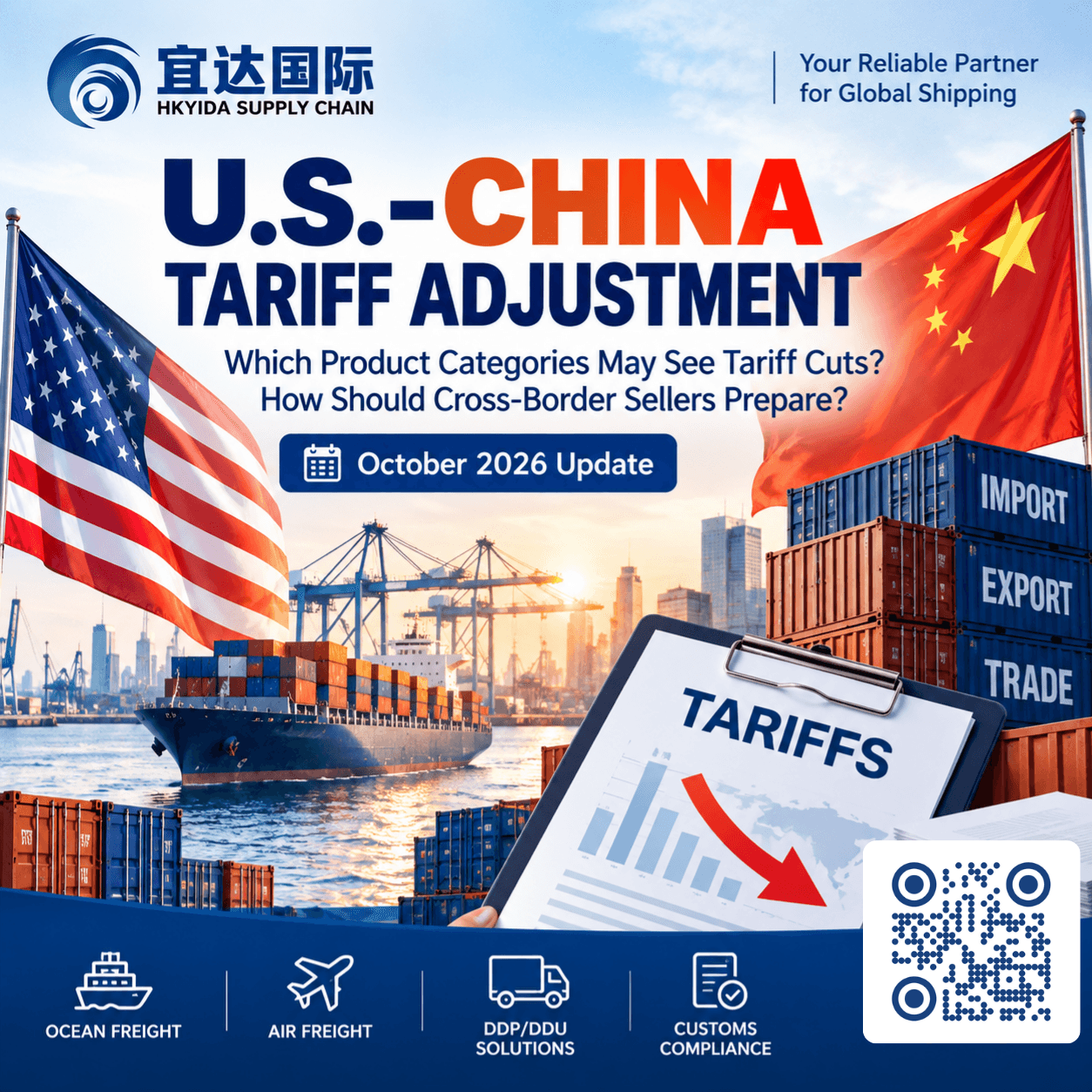
US-China Tariff Adjustment Watch — October 2026

- Version
- Download 296
- File Size 4.73 MB
- File Count 1
- Create Date October 21, 2026
- Last Updated October 22, 2026
US-China Tariff Adjustment Watch — October 2026
Published: October 2026
Resource type: Trade Policy & Customs Compliance Update
Publisher: YIDA International Freight Forwarding Co., Ltd.
Overview: What Importers Need to Know
The United States and China have published product lists under the U.S.-China Board of Trade’s “30-for-30” framework, identifying goods that may be considered for reciprocal, reduced tariff treatment.
On September 27, 2026, the White House published the lists of products recommended for consideration under this framework. The arrangement focuses on roughly USD 30 billion in goods on each side, with any future tariff changes subject to the countries’ respective domestic legal processes.
The key point for importers: publication of a recommended product list does not, by itself, establish that a tariff has been reduced or that a particular shipment qualifies for lower duties. Importers must verify the precise tariff classification, product description, applicable tariff measures and latest official implementation instructions.
This YIDA update explains the framework, highlights product groups appearing on the published U.S. import list, and outlines practical steps for businesses sourcing goods from China for the U.S. market.
What this update covers
- The U.S.-China Board of Trade “30-for-30” framework.
- The difference between recommended tariff treatment and an implemented tariff change.
- Product groups appearing on the published U.S. import list.
- Why the precise U.S. Harmonized Tariff Schedule (HTSUS) classification matters.
- Section 301 tariffs and the need to check other applicable duties.
- Practical preparation for importers, manufacturers and cross-border e-commerce sellers.
- Official sources for checking tariff classifications and policy developments.
Official announcement: The White House — U.S.-China Board of Trade, September 27, 2026
1. What Is the US-China “30-for-30” Framework?
The framework is a bilateral mechanism under the US-China Board of Trade. It identifies lists of U.S. and Chinese goods for consideration for reciprocal, reduced tariff treatment.
The framework is intended to cover roughly USD 30 billion in trade on each side. The September 27 announcement described the published product lists as recommendations for potentially more favorable treatment in the future.
The arrangement is not a blanket cancellation of US tariffs on Chinese imports. The legal treatment of an individual product depends on the applicable measures, the exact tariff classification and any subsequent official action.
Official references:
- White House — U.S.-China Board of Trade and product lists
- USTR — Announcement on the Board of Trade recommendations
- Terms of Reference for the “30-for-30” Framework
2. Which Product Categories Appear on the Published US Import List?
The published US import list includes specified HTSUS tariff provisions for a range of consumer and household products. Examples include:
- Selected plastic plates, cups, bowls and kitchenware.
- Certain household textiles, bed linen and table linen.
- Selected household electrical appliances, including some food-preparation appliances, shavers, irons, microwave ovens and coffee or tea makers.
- Certain Christmas decorations and artificial flowers.
- Specified toys, games, sports and recreational goods.
- Selected household products such as pillows, cushions, sleeping bags and vacuum flasks.
These examples summarize descriptions appearing in the published list. They do not mean that every product in any of these broad categories qualifies for reduced tariff treatment.
Some tariff provisions have product-specific exclusions or limitations. The exact HTSUS code, the complete legal description and any stated exclusion must be checked before drawing a conclusion about a product.
Official U.S. import list:
Download the U.S. Import List published by the White House
3. Does Being on the List Mean the Tariff Has Already Been Reduced?
No. The September 27 publication identifies products recommended for reduced tariff treatment. The framework’s terms of reference state that future tariff reductions will be determined and implemented in accordance with each side’s domestic legal processes.
Importers should therefore distinguish between:
- A product appearing on a recommended list.
- An official legal or administrative measure implementing a tariff change.
- The tariff treatment that actually applies to a specific import entry.
These are separate questions. Do not change a landed-cost calculation, promise a customer a lower duty rate or revise a quotation solely because a product appears on a recommended list.
Before relying on a tariff change, check the latest official U.S. government notices and the tariff provisions applicable to the entry date.
4. How Section 301 Tariffs Affect Import Planning
Section 301 tariffs are additional duties imposed under U.S. trade actions. Their applicability depends on the relevant legal action and tariff classification.
A product may be subject to a base duty rate and one or more additional measures, depending on its classification, origin and applicable rules. A recommendation for future tariff treatment does not automatically establish which existing duties will be removed, reduced or retained.
For each product, importers should confirm:
- The correct U.S. HTSUS classification.
- Whether the product is covered by an existing Section 301 action.
- The current additional duty rate and any applicable exclusions.
- Whether a new official measure has changed the treatment.
- Whether other duties, trade remedies or product-compliance requirements apply.
Official classification resource:
USTR — Search Section 301 tariff actions by HTS subheading
Use the applicable official tariff information and consult a qualified customs broker or trade-compliance professional where classification or duty treatment is uncertain.
5. Five Practical Steps for Importers and Cross-Border Sellers
Step 1: Confirm the HTSUS code for each product
Prepare a list of your main stock-keeping units (SKUs), product descriptions and U.S. tariff classifications. Do not rely solely on a supplier’s general product name or an informal category description.
Step 2: Check the exact wording of the official list
Compare the full tariff provision and product description. Pay particular attention to product-specific exclusions and limitations.
Step 3: Maintain a baseline cost calculation
Continue to calculate costs using the tariff treatment that is confirmed to apply. Treat any unimplemented reduction as a potential future change—not a guaranteed saving.
Step 4: Verify changes before revising quotations or inventory plans
Before promising a lower landed cost, increasing inventory or changing a customer quotation, confirm the effective measure, relevant date and eligibility of the specific product.
Step 5: Monitor official notices and compliance requirements
Tariffs are only one part of import planning. Product safety, labeling, origin, intellectual-property, customs-entry and other applicable requirements may continue to affect market access.
6. What Should Businesses Do Next?
The most useful preparation is product-specific rather than category-wide.
Importers should assemble their product descriptions, supplier information, origin details and HTSUS codes. They can then compare those details with the official lists and monitor subsequent government notices for any implemented changes.
Manufacturers and cross-border sellers should also keep alternative cost scenarios, avoid promising unconfirmed duty savings and review quotations when the actual applicable treatment has been established.
For logistics planning, remember that a tariff change does not by itself confirm freight availability, shipping rates, customs-clearance outcomes or delivery times. Those depend on the specific shipment and the services available for it.
Frequently Asked Questions
Have U.S. tariffs on Chinese imports been eliminated?
No. The U.S.-China “30-for-30” framework does not represent a blanket cancellation of tariffs. The published lists identify products recommended for consideration for reduced tariff treatment, with future changes subject to domestic legal processes.
Which Chinese products may qualify for reduced U.S. tariff treatment?
The published U.S. import list includes specified tariff provisions covering selected household goods, textiles, appliances, toys, decorations and recreational products, among others. Eligibility must be checked against the exact HTSUS provision and its full description.
Does a product qualify simply because it belongs to a listed category?
No. A broad commercial category is not sufficient. The precise tariff code, legal product description and any exclusion or limitation must be checked.
Are Section 301 tariffs the only duties an importer should review?
No. Importers should check all applicable duties, trade measures and product-specific requirements for the goods and entry concerned. The treatment depends on the actual product classification, origin and current rules.
What should Amazon sellers and other cross-border businesses do now?
Prepare accurate product descriptions and HTSUS codes, check the official list, maintain cost calculations based on confirmed rules and avoid promising tariff savings before the applicable change is officially implemented.
Where can I verify the official tariff information?
Start with the White House’s U.S.-China Board of Trade announcement and the USTR Section 301 tariff search resource. Confirm current requirements before making import or purchasing decisions.
Related YIDA Shipping Resources
DDP/DDU Shipping Solutions
Learn how YIDA reviews DDP, DDU and related delivery-term requirements, including customs responsibilities and door-to-door delivery arrangements.
Link:
https://yidaship.com/ddp-ddu-shipping-solutions/
Air Freight Services
Explore YIDA’s air freight options for international shipments where air transport may suit the cargo, delivery requirements and available routing.
Link:
https://yidaship.com/air-freight-services-yida-international-freight-forwarding/
Ocean Freight Services
Learn about YIDA’s FCL and LCL ocean freight services and international shipping options.
Link:
https://yidaship.com/ocean-freight-services/
China-to-Europe CMA Sakura Express Guide
Explore the China-to-Europe ocean freight guide covering CMA Sakura Express routing, transit-time considerations and Europe DDP/DDU delivery options.
Link:
https://yidaship.com/download/cma-sakura-express-europe-shipping/
Shipping Pricing & Resources
Browse YIDA’s freight pricing, rate sheets, shipping guides, customs resources and international logistics updates.
Link:
https://yidaship.com/freight-pricing-download-center/
Contact YIDA
Request a shipment-specific freight quotation and provide the details needed for the team to review your requirements.
Link:
https://yidaship.com/contact-yida-international-freight-forwarding/
Need a Confirmed Freight Rate?
Send us your origin, destination, cargo details and shipping requirements — our team will review your shipment and provide the best available option.
Disclaimer
This resource is provided for general information only and is not legal, customs, tax or financial advice. The publication of a product list does not by itself establish that a tariff reduction has taken effect or that a particular shipment qualifies for different treatment. Regulations and administrative instructions may change. Always check current official sources and consult a qualified customs broker or trade-compliance professional before making a customs declaration or commercial decision.
YIDA International Freight Forwarding Co., Ltd.
Website: https://yidaship.com/
Email: [email protected]
WhatsApp: +86 137 1585 2726
Need a Confirmed Freight Rate?
Send us your origin, destination, cargo details and shipping requirements —
our team will review your shipment and provide the best available option.